


Methane is released in agricultural activities such as rice farming and cattle ranching. Methane is also produced from the decay of organic material in landfills and sewage treatment plants. Extraction and leakage of natural gas release methane. In 2012, CH4 accounted for about 9% of all U.S. greenhouse gas emissions from human activities. Wetlands produce lots of methane. Due to this high level of water saturation as well as warm weather, wetlands are one of the most significant natural sources of atmospheric methane. Acetoclastic methanogenesis is a process where acetate (CH3COOH) is split into CO2 andCH4.
CH3COOH ---> CO2 + CH4
In 2012, nitrous oxide (N2O) accounted for about 6% of all U.S. greenhouse gas emissions from human activities. Two thrids of nitrous oxide comes from the management of livestock feed and waste. The rest comes from nitrogen fertilizers, industrial processes and fossil fuel use. Nitrous oxide is produced naturally by the reaction of bactaria in soil and water. Nitrous oxide can be produced by heating ammonium nitrate, which decomposes into nitrous oxide and water vapour.
NH4NO3 (s) → 2 H2O (g) + N2O (g)
The water vapours are the gas state of water. It turns to gas in the process of evaporation. About two-thirds of earth's natural greenhouse effect is caused by water vapour. The quantity of atmospheric water vapour depends on temperature of the atmosphere. It varies from trace amount of about 4 percent. Water evaporate readily when it is heated and warmer air is able to hold more water vapour. The warmer the temperature is, more water evaporates. Water vapour traps energy, which warms the earth when there is large amount of water vapour in the atmosphere.

Emission
How are these greenhouse gases emitted?
Carbon Dioxide
(CO2)
Methane
(CH4)
Water Vapour
(H2O(g))
Nitrous Oxide
(N2O)
Carbon dioxide is mainly produced by human activities. We burn fossil fuel to get energy and use in transportation, heating, electricity generation, and industry. In 2012, CO2 accounted for about 82% of all U.S. greenhouse gas emissions from human activities. Carbon dioxide cause up to a quarter of the natural greenhouse gases. Volcanic erruption, burning of organic matter, and cellular respiration are the examples of natural sources of atmospheric carbon dioxide. Trees play a major role in the amount of carbon dioxide will remain in the atmosphere. Trees take carbon dioxide and use it in photosynthesis.
6CO2 (carbon dioxide) + 6H2O (water) + light energy --> C6H12O6 (glucose) + 6O2 (oxygen) is the chemical equation for photosynthesis. 10 percent of our carbon dioxide emissions are caused by deforestation. The trees stop absorbing carbon and release carbon that was previously absorbed into the atmosphere as carbon dioxide.The forest waste decomposes and produce large amount of greenhouse gases, such as carbon dioxide and methane.
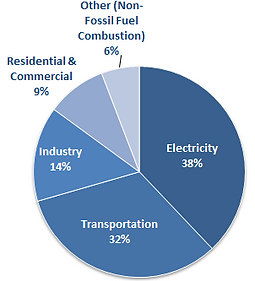


U.S. Nitrous Oxide Emission
U.S. Carbon Dioxide Emission
U.S. Methane Emission
Fun Facts:
-
Each and every second 310 Kg of toxic chemicals are released into our air, land, and water by industrial facilities around the world.
-
This amounts to approximately 10 million tons of toxic chemicals released into our environment by industries each year.
-
Of these, over 2 million tons per year are recognized carcinogens. This amounts to about 65 Kg each second.